Work done within the framework of the NZ Construction Contracts Act requires careful management of the Payment Claims and sub-contractor Retentions – often over a long time period depending on the contract conditions. Many businesses manage their payment claims and sub-contractor retentions using spreadsheets, which can be error prone and are not integrated with their core business systems.
Abel ERP’s Payment Claims and Sub-Contractor Retentions enables these functions to be driven from within the ERP system. Claim documents are created from Customer Order lines or Customer Quote lines and their associated BOMs. Invoices generated from Claims provide retention behavior that complies with the Act.
- A Claim document is created in Abel for a construction contract. The Claim document groups together manufacturing and installation on-site jobs that are for the same contract, providing an overview of the whole contract and streamlining the invoicing process.
- Using the Claim document, the user can build the manufacturing jobs, raise the Payment Claim invoices and view summary data.
- The work is invoiced according to the Value of Work Done. The VOWD percentages are entered by the user and then the invoice is generated.
- Construction Retentions are usually released in two parts: 50% on practical completion and 50% at the end of the defect liability period.
- Abel accounts for sub-contractor retentions in accordance with the Construction Contracts Act and ensures the revenue and GST are accounted for at the correct times.
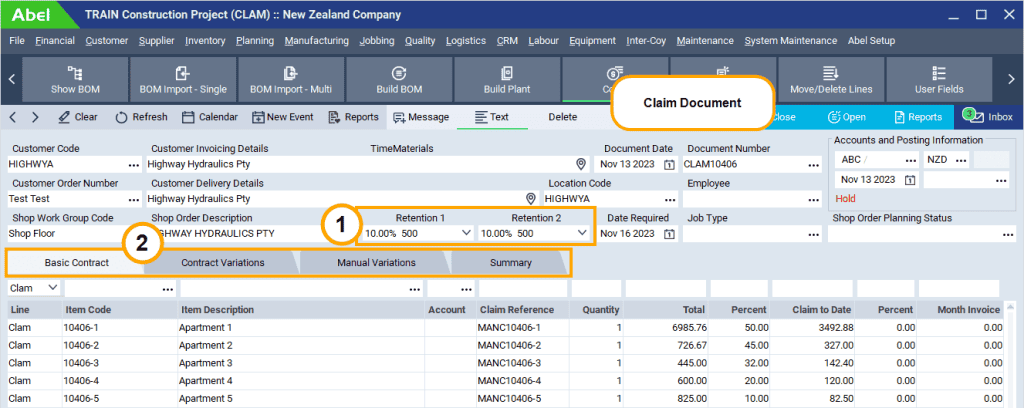
This example shows a Claim document with multiple manufactures for a contract:
- The header provides for the two retention percentages.
- The table has four tabs. The first tab shows the contract line-items…
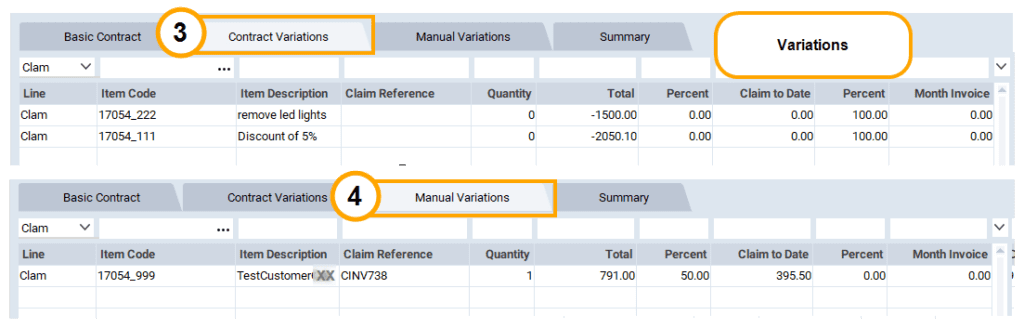
3. The second tab shows Contract Variations. These are negotiated discounts or credits that are agreed to. They are taken into account for invoices using the same percentage process as for contract items.
4. The third tab shows “True” Manual Variations, including BOMs, for additional work agreed with the customer.
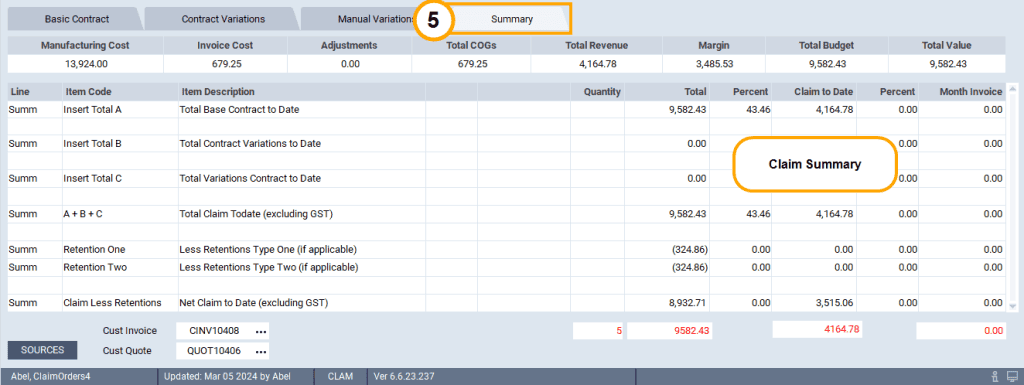
5. The fourth tab shows summary of the first three tabs. This provides an overview of the contract, claimed (invoiced) to date and retention amounts.
Manufacturing and Scheduling for Construction Contracts
Abel tracks multiple Manufacturing Jobs for a Construction Contract (Claim). Functionality includes:
- Capture labor time for both manufacturing and installation on-site jobs
- Capture materials for each manufacturing job
- View a schedule showing the status of all the manufacturing jobs for a selected Claim :