
Maintaining fulfilment control in distribution businesses
In our recent articles on operational control for distribution, logistics and fast-moving consumer goods (FMCG) businesses, we looked at why business growth often introduces new coordination challenges, and what stronger control looks like in practice. For distribution businesses, those coordination challenges do not stop once information has been captured and decisions have been made. They also show up when customer orders need to be fulfilled.
As distribution volumes increase, inventory, suppliers, warehouses, transport schedules, and customer expectations all become more difficult to coordinate. A customer order that looks straightforward at entry can quickly become a series of fulfilment decisions: what can ship now, what needs to wait, what has been promised, and how each delivery will be managed.
The challenge is maintaining visibility across multiple deliveries, understanding what remains outstanding, and knowing when inventory is available to fulfil the remaining order lines.
A single order can create multiple fulfilment events
Consider a common distribution scenario.
A customer places a large order containing multiple products. Some inventory is available immediately. Some is due to arrive from suppliers later in the week. Certain products may need to be delivered first to meet customer requirements, while others can follow in a later shipment.
In another situation, the full order may simply be too large for one truck. What appears in the system as one customer order becomes several deliveries that need to be planned, picked, despatched, tracked, and completed over time.
Orders may be partially shipped, split across multiple despatches, or fulfilled in stages as stock becomes available.
When fulfilment becomes harder to coordinate
Warehouse teams often need to manage several competing priorities at once.
Customers want accurate delivery commitments. Sales teams need to know what has been supplied and what remains outstanding. Warehouse staff need clear picking and despatch instructions. Purchasing teams need visibility of demand and inventory requirements. Management needs confidence that customer commitments are being met.
When fulfilment relies heavily on manual tracking, spreadsheets, emails, or individual knowledge, that coordination becomes harder to sustain.
Questions such as these become common:
- What has already been shipped?
- What remains outstanding?
- Which quantities have been allocated?
- Which deliveries are scheduled next?
- Can the remaining items still meet the customer’s required date?
- Has inventory already been committed elsewhere?
As order volumes increase, answering these questions can take significant manual effort. Teams spend more time checking information, coordinating activity, and confirming customer commitments, making it harder to maintain a complete view of fulfilment progress.
Where order-level visibility falls short
Many businesses manage customer orders effectively when fulfilment happens in a single shipment. The process is relatively simple: receive the order, pick the goods, despatch the order, and complete the transaction.
When customer orders are fulfilled across multiple deliveries, fulfilment often needs to be managed at a more detailed level.
Some order lines may need to ship immediately while others remain outstanding. Quantities may need to be adjusted to reflect available stock. Multiple despatches may be required from the same customer order. Warehouse teams need to see both what has already been supplied and what still requires action.
That level of visibility is important when customer orders are fulfilled over time and across multiple deliveries.
Managing fulfilment across multiple deliveries
Customer order fulfilment may require multiple deliveries. The ability to fulfil customer orders in stages can help businesses:
- Respond faster when only part of an order is available
- Improve delivery planning and truck utilisation
- Maintain service levels during supply constraints
- Reduce delays caused by waiting for complete order fulfilment
- Keep customers informed about delivery progress
- Maintain visibility of remaining commitments
Most importantly, staged fulfilment helps businesses continue serving customers while maintaining visibility and control over inventory movements, delivery activity, and customer commitments.
Supporting fulfilment control at the order-line level
Abel’s Despatch Builder screen enables you to manage fulfilment at the order-line level. Warehouse teams can manage outstanding customer order lines, create full or partial despatches, and maintain visibility of remaining fulfilment commitments from a single workspace:
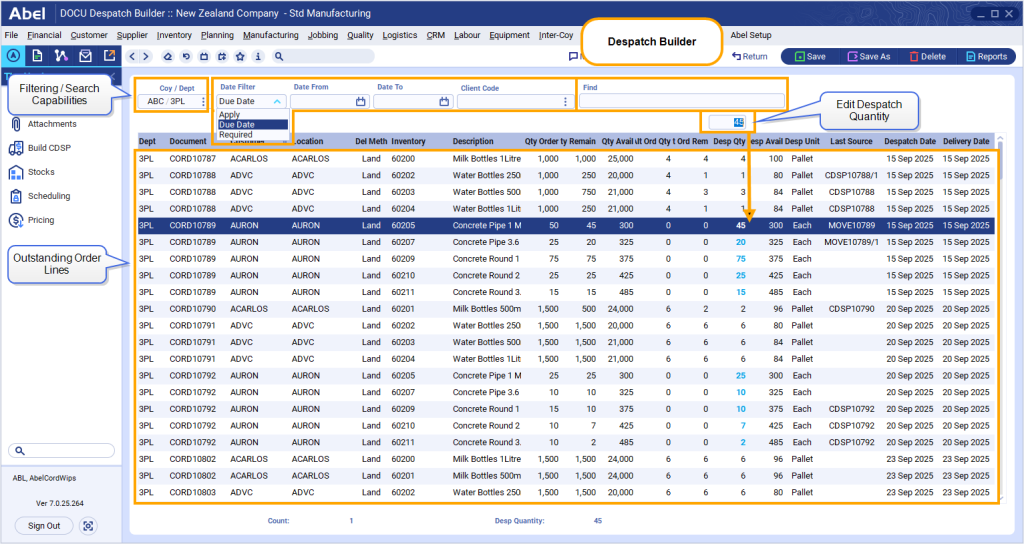
Maintaining control over partial and staged fulfilment requires more than warehouse effort. It depends on connected processes that allow teams to track what has been supplied, what remains outstanding, and how customer commitments are progressing.
Within Abel ERP, the Despatch Builder process supports this by allowing customer orders to be managed at the order-line level, rather than only at the document level. Warehouse teams can build despatches from selected order lines, process partial quantities where required, and maintain visibility of quantities that still need to be fulfilled.
Large customer orders can be split across multiple despatches while retaining their connection to the original customer order. This helps businesses manage staged deliveries, partial shipments, and multi-load despatches while maintaining visibility of customer commitments and inventory movements.
How Abel supports fulfilment control
Businesses are better positioned to manage increasing fulfilment volume when they can maintain visibility, coordination, and control throughout the fulfilment lifecycle, from order capture through to final delivery.
Abel ERP helps distribution, logistics and FMCG businesses manage inventory, warehousing, fulfilment, traceability, purchasing, and finance within a connected operational environment. Capabilities such as line-level despatch processing, barcode scanning, batch tracking, serial number control, and multi-warehouse inventory management help businesses maintain operational control as fulfilment volume increases.